Mayor Mary Ferdon said she feels better about state funding after lawmakers continue working on property tax cuts. Landscaping is almost done at NexusPark and details of a new noise ordinance.
In this week’s installment of Ask The Mayor, Columbus Mayor Mary Ferdon addresses these issues and more during a visit to Columbus City Hall. Listen to the full conversation with Indiana Newsdesk anchor Joe Hren by clicking on the play button above, or read some of the questions and answers below. A portion of this segment airs 6:45 and 8:45 a.m. Wednesday on WFIU. Here are some highlights.
This conversation has been edited for clarity and conciseness.
Hren: We move into the second half of the legislative session. Governor Mike Braun says he's predicting a wrestling match over property tax reform, but he's confident lawmakers will find a happy medium. What are you bracing for coming from the state house?
Ferdon: I like what the House of Representatives have done with their bill, and I think it's a better feel for the local city. We still aren't 100% sure how much we would lose with property taxes, but I think with a lot less than the Senate Bill One, and I had a good conversation with Representative Ryan Lauer last week, I've been talking with our senator, Greg Walker, and they're both on the same page. They understand that as a community, we can't exist for long periods of time with a tax cap on property taxes, with inflation considerably higher, the majority of how we spend our money, aside from schools right at the other local level, is on public safety and people, and so hopefully they will find the right balance.
I'm little bit more confident now than I was a month ago. And so I just really appreciate in our case, that we've been able to talk to our local legislators, and they've been listening in to what we're talking about. So it's a delicate balance. I believe Governor Braun ran on reducing property taxes and eliminating waste and that type of thing. And so it takes time to figure out the right the right way to do that, right?
Read more: Gov. Mike Braun again highlights property tax relief in invite-only roundtable
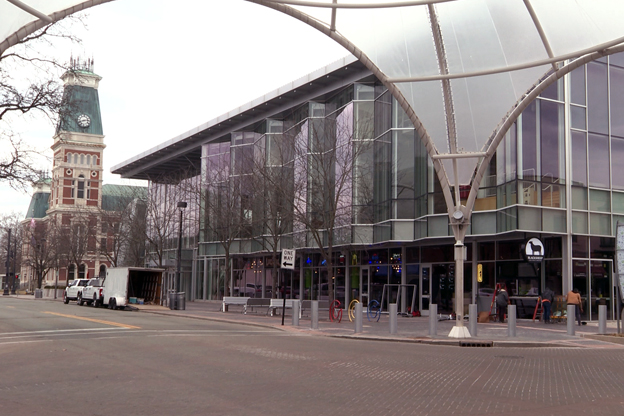 Downtown Columbus Tuesday afternoon. (Joe Hren, WFIU/WTIU News)
Hren: You mentioned in your the State of the City address that NexusPark is booked solid. Is the income starting to match the expenses for that facility?
Ferdon: Our original projections were about three years, so we're in year two. But like last weekend, we had a huge football tournament there. We've got a wrestling tournament with about 1500 people coming in, and then across the street at our Hamilton Center, we have another 1200 ice skaters coming in. So yeah, particularly on the weekends, we're seeing a lot of tournaments coming in and bringing a lot of people to Columbus. So I feel like it's we're really moving in the path that we need to for it to for it to be sustainable.
But I will say to the point that you made, the reason that we held the address in the field house on a Wednesday evening is because that's a busy night for us, and I wanted the community to see that we have pickleball going on, lots of volleyball. We had baseball, the little guys were behind the stage. And, yeah, there were a few times when people said they couldn't hear me over the the noise of the field. And I was okay with that, because I wanted to show that it is being well used by local residents.

- NexusPark sidewalks, sod, landscaping are ready for spring. (Joe Hren, WFIU/WTIU News)
Hren: And the main part is done, right now they're finishing with the campus, the landscaping, right?
Ferdon: Yes, if you've driven by recently, we've got the turf in. We've started putting in most of the trees, got the benches in. The restroom is almost completed. It's called the Midtown Green, and we will be doing a ribbon cutting the first part of July.
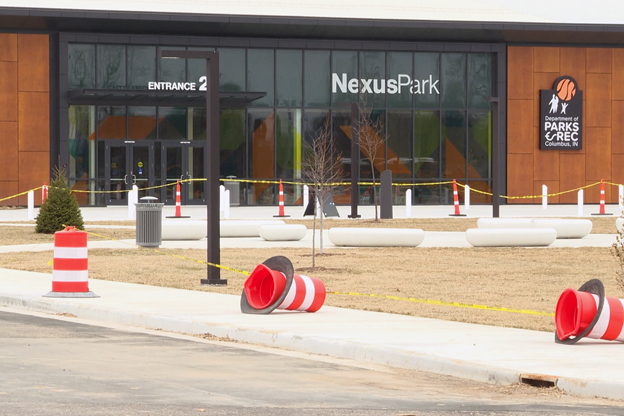
- NexusPark campus landscaping is taking shape. (Joe Hren, WFIU/WTIU News)
Hren: A major part of your address was the lack of housing, housing studies, strategies, and you were talking all levels of housing.
Ferdon: This morning at our Board of Works meeting, we officially adopted the housing study we completed, and it's really some guidelines and a lot of recommendations that we've already started putting into play. Our redevelopment commission is using that as they provide TIF dollars as some developers come in, they have TIF dollars that we use because we are putting a priority on housing, we've been able to use it to help.
We had two local developers who got some of those Indiana tax credits that are so difficult in order for them to move forward with projects. Both of those are low income. One actually has senior care and child care, so we're really excited about that.
Basically, what we've found, is that we need to create 300 housing units per year till the year 2035. Well, that's huge, but now we have a target. So what does 300 look like, right? Is it single family homes? Is it multi family? Do we try to go to tiny homes? Part of what came out of the recommendations of the study was what we needed to do zoning wise through our planning department, which allowed us to look a little bit differently at accessory dwelling. Right? Which allows you maybe to move your in laws, or you maybe not your in laws, but your parents into your backyard, right? And so these are just options.
Hren: Sometimes people get upset at cities if they're developing too quick, or why is this big building going up downtown? But, the city isn't building it, a developer is building, the city is just trying to entice developers. But then, as we saw in Bloomington, there's this need for workforce housing, but there's all these open apartments because the rent is too high? So, how much can the city do?
Ferdon: The city can provide incentives and economic tools. TIF is one area doing a study of, in fact, as we have a developer who needed that study done and adopted, which helps them go after tax credits that we can get through the state of Indiana. It also helps us focus on the kind of development that we would want, right? But I do hear you when you talk about the cost.
Just recently, I was visiting Kansas City, and rents there and housing cost is astronomical. I had a friend who just got back from Boston, and they were talking about what it takes to get into an average home, there's no starter home, right? Homes start in the 3 and 400 thousands. Well, we don't have people who can support that with their income. And so we've got to find a way to attract developers. But developers don't come in and build if they can't make money. And so what can the city offer? Sometimes it's land, right? Sometimes it's TIF dollars. Sometimes it's changing a zoning ordinance that allows it a little bit easier, so we use every tool that we can find.
Hren: I wanted to get a brief background, because I think its on the way through the city council. But there's a new noise ordinance for Columbus? Where did that come from?
Ferdon: It's something that we've been talking about here five to eight years, right? Because there's always somebody who's disrespectful of someone else, right? So this came out of, really, a combination of loud vehicles, fireworks, people playing music too loud. What tools can we give the police department in order to deal with noise? I mean, unfortunately, what happens is in your home or your apartment, you play your music too loud, and I call the police, by the time the police show up, you turned it down. There's nothing that can be done, and then you walk away. So like every community, it's another problem we deal with is noise.